Water Damage from Firefighting
Charlotte, NC — Professional Fire Damage Restoration
Call (704) 471-3454 NowThe fire is out, but the damage isn't done. Fire departments in Charlotte-Mecklenburg use between 150 and 250 gallons of water per minute from each hose line, and a typical house fire requires multiple lines running for 15 to 30 minutes or longer. That means thousands of gallons of water have been pumped into your home on top of the fire damage — water that's now saturating subfloors, pooling in wall cavities, soaking insulation, and seeping into finished basements.
In Charlotte's humid subtropical climate, where summer dew points regularly exceed 70 degrees, the window before mold colonization begins is narrow. Standing water at room temperature starts producing mold growth within 24 to 48 hours. The contaminated water left behind after firefighting — a mix of ash, chemicals, dissolved building materials, and fire retardants — creates an ideal breeding ground for microbial growth.
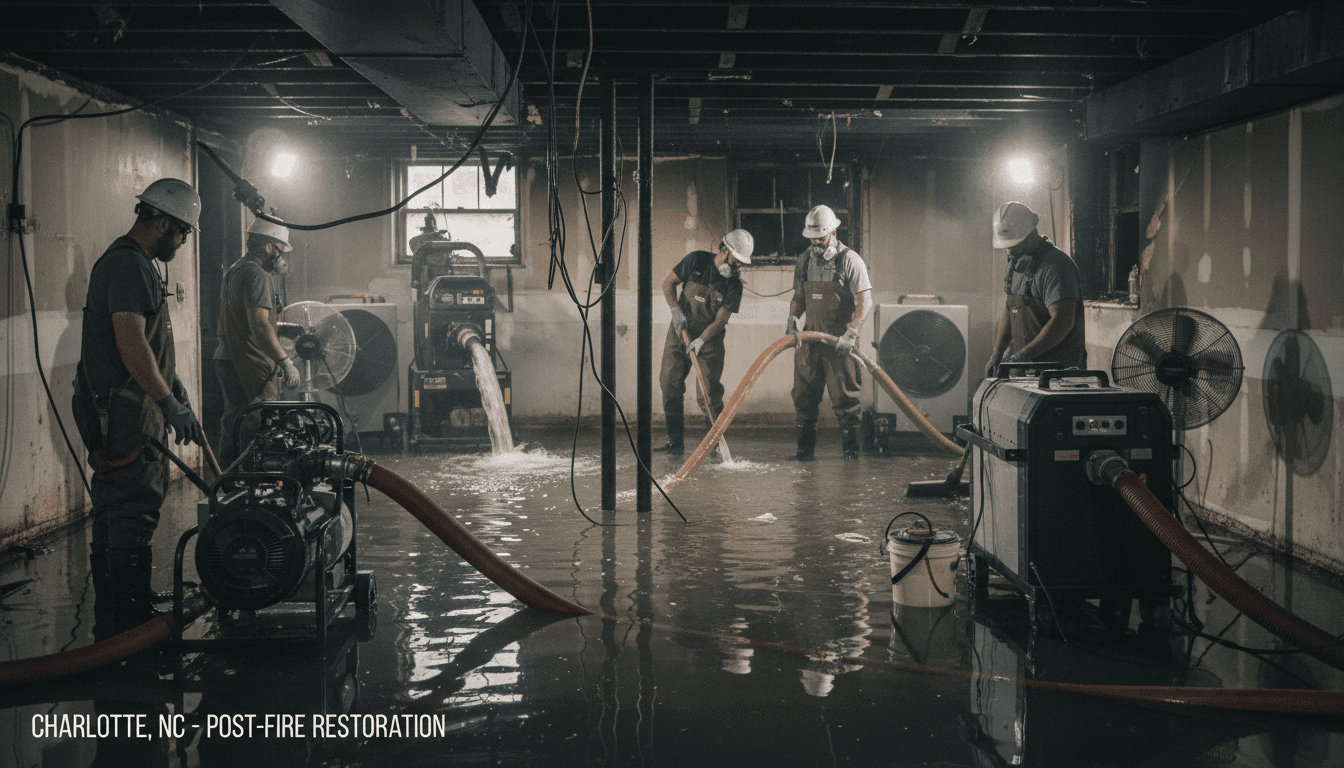
Water damage from firefighting requires specialized extraction and drying equipment that goes well beyond a wet-dry vacuum and a box fan. Our crews deploy truck-mounted extractors, commercial dehumidifiers, and moisture mapping technology to dry your property to pre-loss conditions before mold takes hold. Call (704) 471-3454 for immediate response.
Call Now — 24/7 Emergency Response
The hidden threat: why firefighting water is worse than a leak
A burst pipe produces clean water — what the industry classifies as Category 1. Firefighting water is Category 3: grossly contaminated. It contains dissolved ash, melted synthetics, fire suppression chemicals, and whatever it picked up flowing across charred materials. This water is not just wet — it's toxic. Surfaces that contact Category 3 water require different extraction protocols, different antimicrobial treatments, and in some cases different disposal methods than clean water.
The volume compounds the problem. A residential plumbing leak might release 10 to 50 gallons before someone shuts off the valve. A firefighting operation easily deposits 3,000 to 10,000 gallons into a structure. That water fills wall cavities from the inside, saturates subfloor plywood, and pools above vapor barriers in crawl spaces — all locations where it can't evaporate naturally and where Charlotte's humidity prevents passive drying.
Charlotte homes with pier-and-beam foundations, common in older neighborhoods like Chantilly and Seversville, are especially vulnerable. Water collects in the crawl space, wicks up through floor joists, and creates conditions for wood rot and termite attraction months after the fire is forgotten.
Our water extraction and drying process
We begin water removal the moment the fire department clears the structure. Our truck-mounted extraction units remove standing water at rates up to 180 gallons per minute — we can have the bulk water out of a 2,000-square-foot home in under an hour.
Once standing water is removed, we use infrared thermal cameras and pin-type moisture meters to map exactly where water has migrated. Water follows gravity, but it also wicks sideways and upward through capillary action in drywall, insulation, and wood framing. A floor that feels dry on the surface can have saturated subfloor plywood beneath it. We identify every affected area and set up our drying equipment accordingly.
We deploy commercial-grade LGR (low-grain refrigerant) dehumidifiers and high-velocity air movers in a calculated configuration based on the square footage, material types, and current moisture readings. We monitor daily with data loggers and adjust equipment placement until every material reaches its dry standard — the moisture content it would have under normal conditions for Charlotte's climate zone.
For hardwood floors — a signature feature of homes in Cotswold, Madison Park, and Providence Plantation — we use specialty floor drying mats that inject warm, dry air between the flooring and subfloor. This technique saves hardwood that would otherwise need to be torn out and replaced, often saving homeowners thousands of dollars.
Mold prevention after fire-related water damage
Charlotte averages 43 inches of rainfall per year and summer relative humidity regularly tops 80 percent. That ambient moisture means your home is already working against you when it comes to drying. Add several thousand gallons of contaminated firefighting water and the clock is ticking fast.
Our mold prevention protocol starts during extraction. We apply EPA-registered antimicrobial agents to all affected surfaces as we expose them. Wet insulation is removed immediately — fiberglass and cellulose insulation cannot be effectively dried in place and become a mold incubator within 48 hours. We open wall cavities strategically to access trapped moisture, using controlled demolition that removes only what's necessary.
We run continuous air quality monitoring throughout the drying process. If spore counts begin to rise, we add HEPA air scrubbers to the affected zones. Upon completion, we perform a final clearance test and provide written documentation of moisture readings and air quality results — documentation your insurance company will want to see.
Structural drying for Charlotte construction types
Charlotte's building stock ranges from 1920s Craftsman bungalows in Wesley Heights to 2020s production homes in Ardrey Kell. Each construction type holds and releases water differently, and a one-size-fits-all drying approach leaves hidden moisture behind.
Slab-on-grade foundations, common in much of south Charlotte, trap water between the concrete and flooring. We use above-slab drying systems that create negative pressure to pull moisture up through the concrete and into our dehumidification equipment. Pier-and-beam crawl spaces require below-floor drying with sealed crawl space protocols. Two-story homes need cavity drying on upper floors where water runs down through wall framing into the floor system below.
We tailor every drying plan to the actual construction of your home — not a generic template. This approach consistently gets Charlotte properties to dry standard 30 to 40 percent faster than industry averages.
Mold doesn't wait, and neither should you. Every hour that firefighting water sits in your walls and floors, the restoration cost climbs and the health risk grows. Call (704) 471-3454 right now — our Charlotte water extraction crews are standing by and can begin pumping within hours of your call.
(704) 471-3454