Odor Removal & Air Purification
Charlotte, NC — Professional Fire Damage Restoration
Call (704) 471-3454 NowSmoke odor is the last thing to leave and the hardest thing to eliminate. Long after the soot is cleaned, the water is dried, and the structure is rebuilt, smoke odor persists — embedded in concrete, trapped in insulation, absorbed into wood framing, and hiding in every porous material the fire's smoke touched. A freshly painted room can smell clean for a week and then begin releasing smoke odor as temperature and humidity fluctuate. Charlotte's hot, humid summers are particularly effective at reactivating odor compounds that seemed to have been eliminated.
Smoke odor is not a single chemical — it's a complex mixture of hundreds of volatile organic compounds (VOCs) produced by combustion. Different materials produce different odor compounds: burned protein (food, hair, wool) creates a sharp, acrid smell; burned synthetics (carpet, plastic, foam) produce a chemical, petroleum-like odor; burned wood generates the familiar campfire smell but in concentrations far above what's pleasant. A typical house fire produces all three types simultaneously.
Masking smoke odor with air fresheners, scented candles, or fragrance sprays is like turning up the radio to ignore a check engine light. The odor compounds are still there, still off-gassing, and still affecting your indoor air quality. Permanent odor elimination requires identifying every source, treating it with the correct technology, and verifying the results with objective testing. Call (704) 471-3454 for professional odor assessment and elimination.
Call Now — 24/7 Emergency Response
Why smoke odor persists after cleaning
Smoke travels as a gas carrying microscopic particles. When it contacts a surface, the particles adhere through electrostatic attraction and physical embedding, while the gaseous odor compounds absorb into the material through a process called adsorption — the molecules bond to the surface at a molecular level. This is why you can wipe a surface visibly clean and still smell smoke: the visible soot particles are gone, but the odor molecules remain embedded in the material's structure.
Porous materials absorb the most odor. Concrete, wood framing, drywall paper facing, carpet padding, insulation, and natural textiles all have microscopic surface structures that trap odor compounds. Non-porous materials like glass, metal, and glazed tile hold odor on the surface only and respond well to cleaning alone.
Charlotte's climate creates an additional challenge. High humidity causes porous materials to expand slightly at the molecular level, releasing trapped odor compounds into the air. This is why fire-damaged Charlotte homes often smell worse on humid summer days — the moisture is literally squeezing odor out of the building materials. A home that smells clean during a dry January inspection may become noticeably smoky when June arrives and relative humidity climbs above 70 percent.
Our multi-technology approach to odor elimination
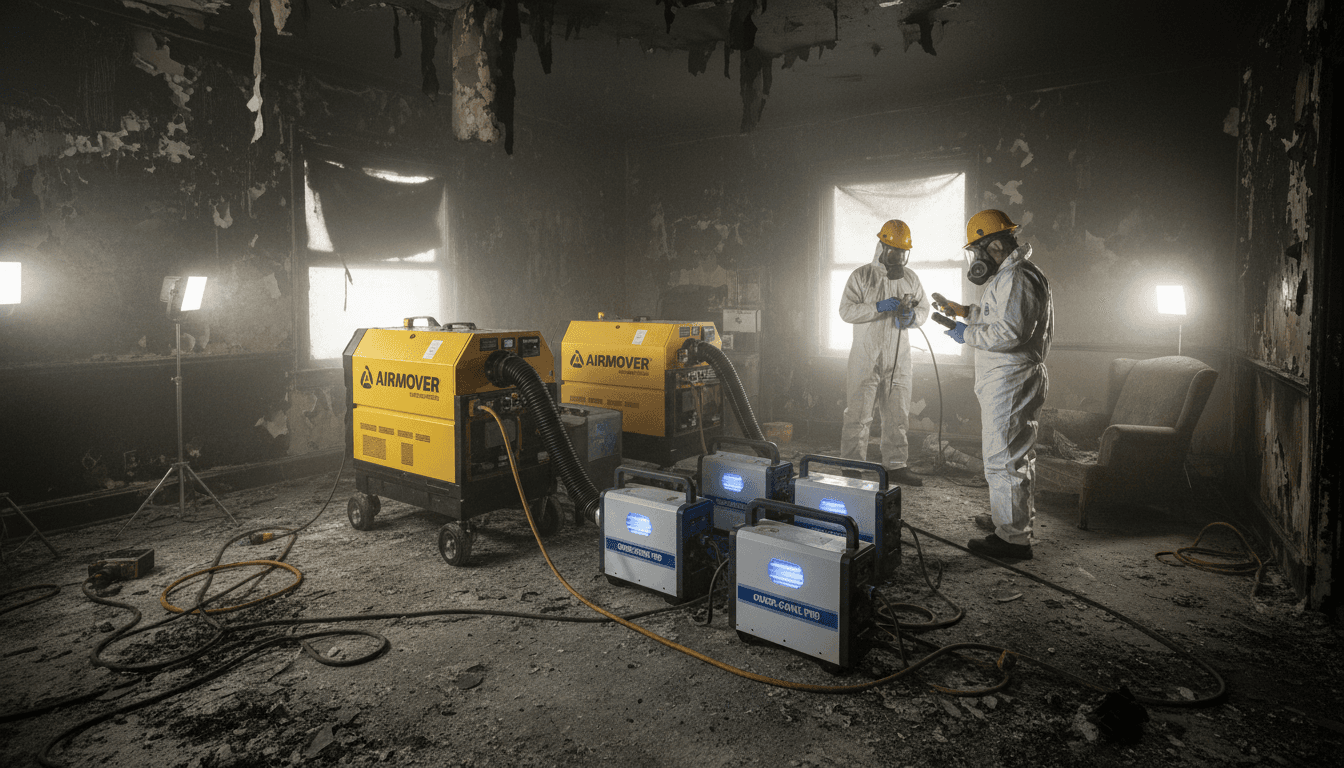
No single technology eliminates all types of smoke odor. Ozone generators are effective on certain compounds but don't penetrate deep into materials. Thermal fogging reaches places ozone can't but doesn't address surface contamination. Hydroxyl generators work continuously in occupied spaces but take longer to achieve results. The most effective odor elimination uses multiple technologies in sequence, matched to the specific odor compounds and materials present.
Ozone treatment: We seal the affected area and run commercial ozone generators that produce O3 concentrations high enough to oxidize odor compounds on contact. Ozone is highly reactive and breaks down VOCs into odorless carbon dioxide and water. However, ozone is also harmful to people, pets, and certain materials, so the space must be unoccupied during treatment and properly ventilated afterward. We typically run ozone for 24 to 48 hours per treatment cycle.
Thermal fogging: We use a heated fogging agent that produces a vapor with particle sizes similar to smoke. This vapor follows the same pathways the original smoke took — into wall cavities, through cracks, into ductwork — and deposits a deodorizing agent that neutralizes odor compounds in place. Thermal fogging is the most effective method for reaching hidden odor sources inside enclosed spaces.
Hydroxyl generation: For spaces that need treatment while occupied or while containing sensitive materials, we deploy hydroxyl generators. These units produce hydroxyl radicals — the same oxidizing molecules that break down pollutants in the atmosphere naturally — at concentrations that eliminate odor without the safety concerns of ozone. Hydroxyl treatment is slower but safe for continuous operation around people, pets, electronics, and artwork.
Encapsulation: For surfaces where odor cannot be fully extracted — such as concrete subfloors, structural wood framing, or masonry — we apply commercial-grade sealants that lock remaining odor molecules into the material permanently, preventing them from off-gassing into the living space.
Air quality testing and verification
We don't declare a job complete based on how it smells to us. Human noses adapt to odors within minutes — a phenomenon called olfactory fatigue — which means subjective assessment is unreliable. Instead, we use objective air quality testing to verify that odor compounds have been eliminated to safe levels.
Our testing measures total volatile organic compounds (TVOCs) using photoionization detector instruments. We establish a baseline reading from an unaffected area of the home or from outdoor ambient air, then compare readings from treated areas. Treatment continues until indoor TVOC levels match baseline within an acceptable margin.
For Charlotte properties where complete odor elimination is critical — such as homes going on the market, rental properties returning to service, or homes with occupants who have chemical sensitivities — we also perform third-party indoor air quality testing through an independent laboratory. This provides a certified report documenting air quality levels, which can be shared with buyers, tenants, or medical professionals.
We also perform a follow-up check 30 days after treatment completion. This timing is deliberate: it allows the home to cycle through multiple temperature and humidity changes, flushing out any residual odor that might have been dormant during the initial testing period. If any odor is detected during the 30-day check, we retreat at no additional cost.
Addressing odor in Charlotte's common building materials
Charlotte's housing stock includes specific materials that present unique odor challenges. Hardwood floors, found in most homes across Myers Park, Dilworth, Plaza Midwood, and Montford, absorb smoke odor into the grain of the wood. Surface cleaning removes soot but not embedded odor. We treat hardwood with a combination of sanding (removing the top layer where odor concentration is highest), sealing with an odor-blocking finish, and ozone treatment of the subfloor beneath.
Concrete slab foundations, common in ranch homes throughout south Charlotte and in most commercial buildings, are deeply porous and absorb smoke compounds that can off-gas for years. We apply penetrating concrete sealers that bond with odor molecules below the surface, followed by a topical encapsulant that blocks any remaining migration.
Attic insulation — whether fiberglass batts or blown cellulose — acts as a massive odor sponge. In most cases, we recommend complete insulation removal and replacement rather than treatment. The cost of removing and replacing attic insulation is typically less than the cost of multiple odor treatment cycles, and new insulation improves the home's energy performance. For Charlotte homes built before 1990, insulation replacement also provides an opportunity to upgrade from R-19 to current energy code minimums of R-38 or higher — a code upgrade that may be covered under your insurance policy's Ordinance or Law provision.
Smoke odor doesn't fade with time — it hides and comes back when Charlotte's humidity rises. If your home still smells like smoke after cleaning, or if you want to make sure odor is eliminated right the first time, call (704) 471-3454. We'll assess the source, deploy the right technology, and verify the results with testing — not guesswork.
(704) 471-3454