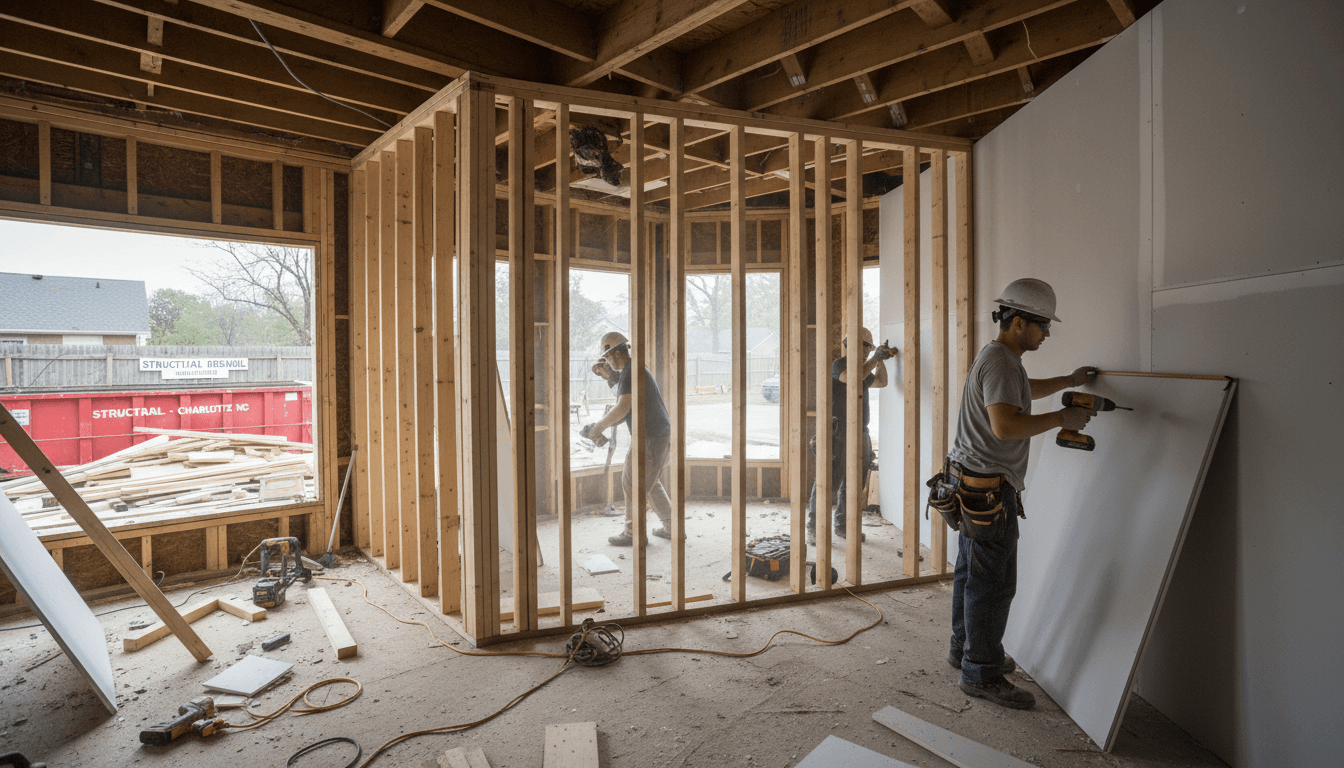
Structural Repair & Rebuild
Charlotte, NC — Professional Fire Damage Restoration
Call (704) 471-3454 NowAfter the smoke clears and the water is extracted, what remains is the structural reality of fire damage: charred framing, compromised load-bearing walls, weakened roof trusses, and foundation stress from thermal shock. A fire that burned for even 15 minutes can reduce the structural integrity of wood framing by 50 percent or more. The house may look like it's standing, but the bones may not be safe.
Structural repair after a fire isn't a cosmetic renovation — it's an engineering problem. Every charred stud, joist, and rafter must be evaluated for remaining load capacity. Connections between structural members — the metal plates, hurricane straps, and fasteners that hold your roof on during Charlotte's summer thunderstorms — lose temper and strength when exposed to heat. The work requires a licensed general contractor who understands both fire damage assessment and North Carolina building code.
We hold a North Carolina General Contractor license and have rebuilt fire-damaged homes and commercial properties across Charlotte, from single-story ranches in Oakdale to multi-story mixed-use buildings in South End. Call (704) 471-3454 to schedule a structural assessment — we'll give you an honest evaluation of what needs repair, what needs replacement, and what the rebuild will involve.
Call Now — 24/7 Emergency Response
Structural assessment: understanding what the fire left behind
Not all fire damage is visible. A stud that looks charred on the surface may retain 80 percent of its structural capacity, while a beam that appears only lightly damaged may have deep charring that reduces it to half its rated load. Appearances are unreliable — measurement is required.
Our structural assessment begins with a systematic evaluation of every framing member in the affected area. We use a combination of visual inspection, probing (inserting a tool into the wood to measure char depth), and where necessary, resistance drilling to measure the density of wood beneath the charred surface. Char depth directly correlates to strength loss: the American Wood Council's Technical Report 10 provides the engineering basis for these calculations.
We also evaluate steel components — lintels, columns, connectors, and embedded plates. Steel exposed to temperatures above 600 degrees Fahrenheit begins losing yield strength, and connections that experienced temperatures above 1,100 degrees may need complete replacement. We use hardness testing on exposed steel to determine whether heat exposure has altered its properties.
The assessment produces a detailed scope of work with engineering justification for every item. This document serves as the basis for your insurance claim, your building permit application with Mecklenburg County, and the construction plan your rebuild will follow.
The rebuild process: from demolition to certificate of occupancy
Our rebuild process follows a defined sequence designed to keep the project on schedule and within the scope approved by your insurance carrier.
Controlled demolition comes first. We remove damaged materials systematically, preserving anything that can be saved and documenting everything that must go. Debris is sorted on-site for proper disposal — fire debris in Charlotte must be handled according to Mecklenburg County solid waste regulations, and certain materials (asbestos-containing materials found in pre-1980 homes, lead paint in pre-1978 homes) require licensed abatement.
Framing repair and replacement follows. We sister new lumber alongside damaged studs where partial strength remains, and fully replace members that have lost too much cross-section to charring. All new framing meets current North Carolina Residential Building Code, which means your rebuilt sections may actually exceed the original construction's structural performance — particularly in older Charlotte homes built before modern code requirements.
Mechanical, electrical, and plumbing rough-in comes next. Fire often damages wiring, copper piping, and HVAC components hidden inside walls. We coordinate licensed subcontractors for each trade, pulling all required Mecklenburg County permits. Charlotte's inspection process requires separate sign-offs for framing, mechanical, electrical, plumbing, and insulation before drywall can be hung.
Finish work — drywall, paint, flooring, trim, cabinetry, fixtures — brings the home back to livable condition. We match existing finishes where undamaged portions of the home remain, so the transition between original and rebuilt areas is invisible.
Navigating Charlotte building permits and code compliance
Any structural repair in Mecklenburg County requires a building permit issued by Charlotte Land Development. Fire rebuilds trigger additional requirements: if more than 50 percent of the structure is damaged, the entire home may need to be brought up to current building code rather than just the repaired sections. This can affect energy code compliance, electrical panel capacity, egress window sizing, and smoke detector placement.
We handle the full permitting process — permit application, plan submission, inspector coordination, and final certificate of occupancy. Our team knows the Charlotte permitting office's requirements intimately, which means fewer revision cycles and faster approvals. For properties in historic districts like Fourth Ward or the Hermitage Court Historic District, we coordinate with the Charlotte-Mecklenburg Historic Landmarks Commission to ensure repairs comply with preservation standards while meeting structural requirements.
Insurance coordination for major rebuilds
Major structural repairs are the most expensive category of fire damage restoration, and they're where insurance disputes most commonly arise. Disagreements over scope, material quality, code upgrade costs, and depreciation can stall a rebuild for months.
We prepare our estimates in Xactimate using current Charlotte-area pricing, and we document every line item with photographs, measurements, and engineering justification. When your carrier's adjuster proposes a lower scope, we negotiate with technical documentation rather than emotion. If code upgrades trigger additional costs — such as bringing the electrical panel up to current NEC standards or adding fire sprinklers to meet current requirements — we file for Ordinance or Law coverage under your policy, a provision many homeowners don't know they have.
Our goal is to get your home rebuilt to at least its pre-loss condition without you paying out of pocket beyond your deductible. We've successfully managed rebuilds ranging from $50,000 single-room repairs to $600,000 whole-house reconstructions across the Charlotte metro area.
Your home's structure determines everything — your family's safety, your insurance settlement, and the timeline to get back to normal. Call (704) 471-3454 for a professional structural assessment from a licensed Charlotte general contractor. We'll tell you exactly what your home needs and build a plan to get you there.
(704) 471-3454